
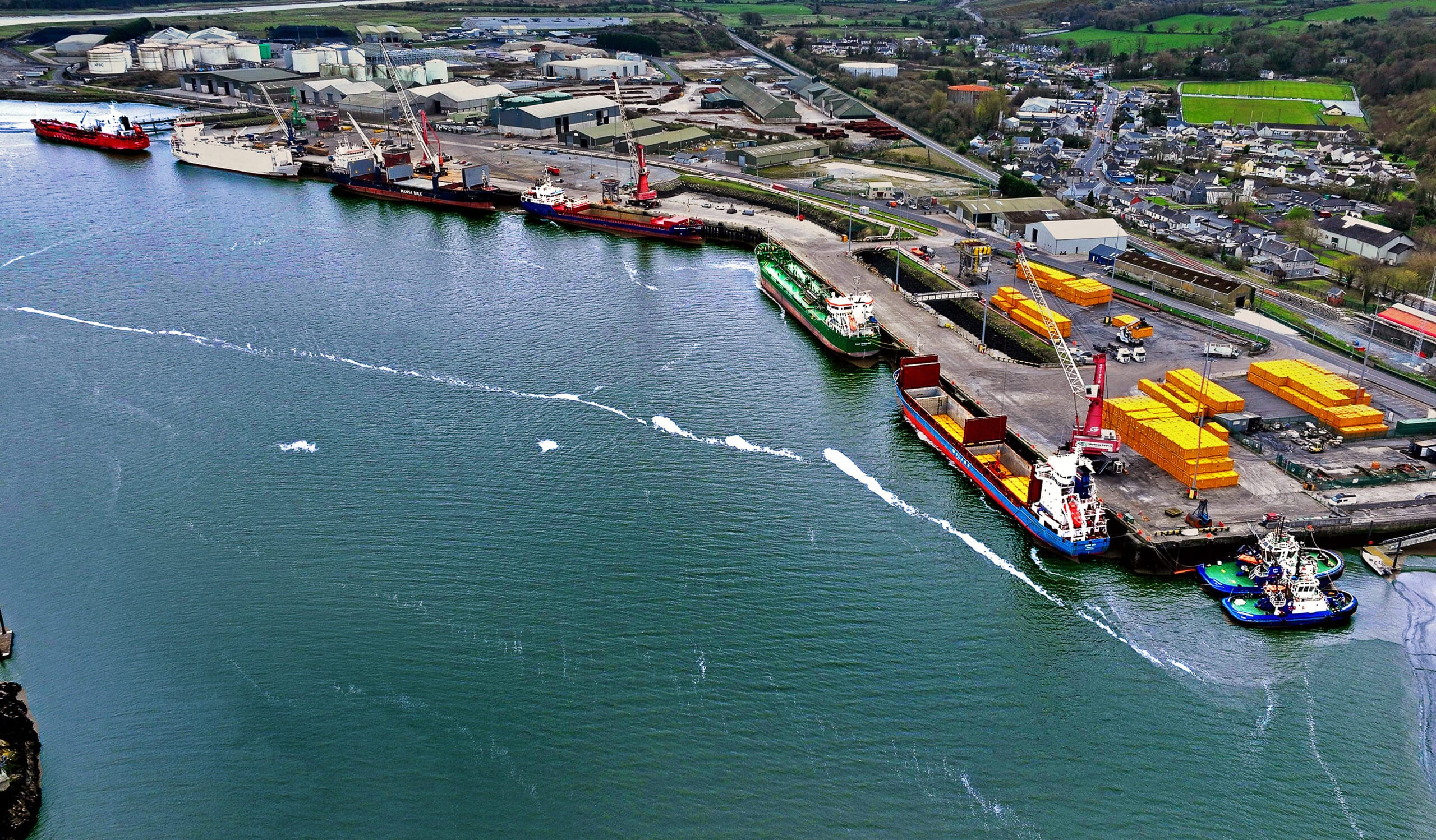
Shannon Foynes Port Company reports record EBITDA and operating profit as revenues rise 12%
Saturday, 17 October 2026: Shannon Foynes Port Company (SFPC) has reported a landmark financial performance for 2025, with turnover rising 12% to €17.63 million and both EBITDA and operating profit reaching historic highs.
The Company recorded EBITDA of more than €8 million for the first time, alongside record operating profit of €5.71 million, up from €4.81 million in 2024. Operating margin increased to 32.4%, while EBITDA margin remained strong at 45.4%.
The result was driven by robust performance across the Port’s operations, including revenue growth at directly managed and privately owned terminals. Ship and cargo revenues increased by €0.8 million, or 10.1%, while total Shannon Estuary throughput rose 2.2% to 9.35 million tonnes. Foynes Port, the Company’s largest terminal, recorded its highest-ever annual tonnage, increasing 10.8% year on year.
The Port ended the year with a balance-sheet value of €71.6 million and net debt of €6.9 million, a reduction of €3 million on the previous year. Net assets were at €72m at year end, increasing by 240% over the ten-year period to 2025.
Capital Additions in the year reached €4.59million, primarily relating to construction work in progress as well as the consenting process for the Foynes Island Deepwater development, which is aimed at accelerating the transformation of the Shannon Estuary into a major international shipping and economic hub, as per the company’s Vision 2041 masterplan. The Company’s shorter-term Strategic Plan 2026-2030 identifies €210 million in planned capital expenditure to develop port facilities and support long-term demand.
Strong performance at SFPC’s Foynes and Limerick ports, together with rental and ancillary income, also helped offset the continuing reduction in power-generation volumes associated with the transition away from coal at Moneypoint, which at one point accounted for 20% of total Shannon Estuary throughput.
Pat Keating, Chief Executive Officer, said: ”These results demonstrate the value of our focus on growing revenues, managing costs and making the most of the capacity and assets at our Foynes and Limerick terminals. Record activity at Foynes, in particular, underlines the Port’s growing role in supporting industry, trade and supply chains across the region and nationally.
“We are continuing to advance the priorities set out in Vision 2041, including the development of Foynes Island Deepwater Port and the delivery of enhanced road and rail connectivity. These investments are central to building the capacity required for offshore renewable energy, sustainable freight and logistics growth, and enabling Ireland’s transition to a lower-carbon economy.”
Mr Keating welcomed the significant continued progress made on Port hinterland connectivity during 2025, with the Adare bypass element on schedule for completion by summer 2027 and advanced enabling works also completed for the entire scheme to Foynes. Financial appraisals are also now underway for the Foynes sections and Mr Keating requested that these are completed in a timely fashion, with completion of the scheme required by 2030 to comply with the Ten-T Regulation and to facilitate projected Port growth.
Also, construction works for the reinstatement of the 40km Limerick to Foynes rail line will see it reopen for freight services in Q1 2027. This will, Mr. Keating said, be a key enabler for the Port to develop sustainable logistic services from Foynes.
“Connecting the national rail network at Limerick to Foynes port will undoubtedly enable national freight modal shift from roughly just 1% today. This modal shift will assist with Ireland’s Climate Action Plan for transport to meet its net zero climate obligations,” he added.
Michael Walsh, Chairperson of Shannon Foynes Port Company said, “2025 was another very positive year for Shannon Foynes Port Company. Our record revenue, EBITDA and operating-profit performance reflects the strength and diversity of our business, the resilience of our operations and the progress being made in delivering our strategic vision for the Shannon Estuary. We are in a strong financial position to continue investing in infrastructure that will support Ireland’s future economic, logistics and energy needs.”
Mr Walsh said that investment in Shannon Foynes has the potential to unlock a chain reaction of societal benefits, including job creation in the local area, cutting carbon emissions and in providing alternative fuel sources. There is, he said, a clear project rationale for supporting the Foynes Island project, with Ireland aiming for 20GW of ORE by 2040 and 37GW by 2050.
The Chairman stated that the Board very much welcomed the launch of the National Designated Maritime Area Plan (NDMAP), which will aim to designate sufficient maritime area to deliver a target of 15GW of offshore renewable energy by 2040, as an “important milestone”. The NDMAP process is critical, he said, to provide more clarity and certainty of future revenue streams and route to market for port developments, including Foynes Island Deepwater Port.